
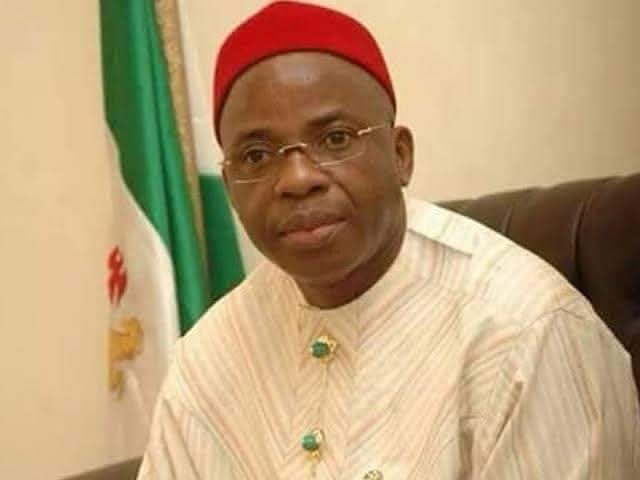
Being a Paper Delivered by His Excellency, Dr. Ikedi Godson Ohakim at the 2026 Synod of the Diocese of Isi-Mbano, St. Paul’s Church, Umuduru
My Lord Bishop, distinguished clergy, Mr. Chairman, esteemed Knights, ladies and gentlemen.
I consider it a profound honour to be found worthy by the Diocese of Isi-Mbano, Anglican Communion, to stand before this distinguished Synod as Guest Speaker on a matter so topical, so sensitive, and so consequential to our common destiny as Ndi Imo.
Permit me to begin by commending this Synod for uncommon courage. The choice of this topic confirms that the Church continues to read the pulse of the faithful and refuses to be indifferent to the issues that shape our polity. It is a reminder that when the Church chooses silence while the political house is unsettled, it abdicates a sacred responsibility — to speak from the podium of faith and guide human endeavour from a divine perspective.
For as it is written, _”When the righteous are in authority, the people rejoice: but when the wicked beareth rule, the people mourn.” — Proverbs 29:2
In that spirit, I crave your indulgence to pardon me for slightly reframing the discourse. Not to dilute it, but to preserve its scholarly integrity and impartiality, so that this reflection may be received not as the lamentation of a participant, but as the contribution of a concerned statesman and student of history.
• What then is a Charter of Equity?Conceptually, it is a memorandum of understanding — willingly entered into by a people with contending interests — deployed as a tool of social engineering to promote justice, fairness, and even distribution of opportunities for social balance.
Its beauty lies in this: it is not imposed; it is negotiated. It reflects consensus arising from robust engagement after due consultation with critical stakeholders whose mandate derives from the people they represent.
Man, as Aristotle noted, is by nature a political animal — a social being navigating shared values and aspirations. From those shared instincts, competition inevitably arises. And when competition is left unregulated, the tendency to grab all available opportunities to the disadvantage of others sets in.
It is precisely that gap — where injustice festers — that makes a Charter necessary. As the Prophet Amos cried, “But let judgment run down as waters, and righteousness as a mighty stream.” — Amos 5:24
Restoration of order only comes when the Charter factors the justice of the case. The beauty of democratic decisions lies in compliance with standard precepts that must not be circumscribed for convenience.
Anything that touches the rights and privileges of citizens must be handled with caution, factoring sensitivities and larger implications. For as our Lord admonished, _”Therefore all things whatsoever ye would that men should do to you, do ye even so to them.” — Matthew 7:12
A proper Charter must be process-driven. Objectives must be clear, steps to build consensus defined, and mechanisms put in place for written submissions endorsed by stakeholders after due consultation. What comes to a zone, why and when, are matters that should be placed on the table of discussion — what the legislature calls public hearing.
The supreme dividend of a Charter is the enthronement of justice. Justice evolves from facts and evidence. A conclave of a few is inadequate to discuss power-sharing that affects the majority. For Scripture reminds us, “In the multitude of counsellors there is safety.” — Proverbs 11:14
Let me be clear: the idea of a Charter of Equity in Imo State is not novel.
- IMO CHARTER OF EQUITY: A HISTORICAL FORENSICS
Contrary to notions in some quarters, the Imo Charter of Equity is not new. In 1989, the political elite led by Chief Sam Mbakwe resolved that Okigwe Zone would not contest the governorship in the transition midwifed by the military. Why? Because Okigwe, through Mbakwe himself, had produced the last elected civilian governor. A deliberate decision was taken to cede the office to Owerri Zone. Consequently, the two major parties, NRC and SDP, fielded only Owerri candidates — Chief Evan Enwerem and Dr. Fabian Osuji, later replaced by Dr. Alex Obi. Enwerem won in 1991.
At the dawn of another transition in 1998, Imo leaders again took a deliberate decision to cede the office to Orlu Zone. Despite having highly eligible candidates from Okigwe, its leaders, including Mbakwe himself, championed power shift to Orlu. APP fielded Dr. Ezekiel Izuogu while PDP fielded Chief Achike Udenwa — both Orlu sons. Udenwa won and was sworn in.
In 2003, there was general consensus that Udenwa should be allowed a second term to complete eight years for Orlu and pave way for Okigwe. Even though Senator Hope Uzodimma, also from Orlu, contested on AD with me as his running mate, head or tail, Orlu would have produced governor.
In 2007, all eyes were on Okigwe to produce Udenwa’s successor. After a protracted contest, Senator Ifeanyi Araraume emerged as PDP candidate, while I became the candidate of the Progressive Peoples Alliance. Chief Martin Agbaso from Owerri Zone contested under APGA. I won the election and was sworn in as governor in 2007.
The general expectation then was that rotation had become norm and tradition.
But in 2011, when it was time for me, and in effect Okigwe Zone, to seek a second term, the consensus fractured. Some elements in Owerri insisted it was their turn. When that argument could not fly, some aligned with Orlu to return to power. Chief Agbaso, then leader of APGA, conceded his party’s ticket to Chief Rochas Okorocha from Orlu. And in that charged atmosphere, personal issues and old grievances found expression.
Prior to that period, I was accused of an incident involving a Catholic priest. The narrative, however inaccurate, was amplified. Security reports later indicated that attempts were made to convince the Presidency that Imolites no longer wanted my administration. A promise was also said to have been made that the Orlu candidate would do only one term and hand over to Owerri Zone — a claim that swayed many faithful at the time.
I warned openly that such an arrangement would be difficult to sustain, but my voice was drowned.
On April 26, 2011, I polled 310,106 votes against Okorocha’s 305,263. The election was declared inconclusive and a supplementary fixed for May 6, 2011. What transpired thereafter is well documented in the public domain.
Power returned to Orlu after eight years of Udenwa and remained there for another eight because the one-term promise was not kept — exactly as I had cautioned. For as Scripture says, “Be not deceived; God is not mocked: for whatsoever a man soweth, that shall he also reap.” — Galatians 6:7
In 2020, power again returned to Orlu after the seven-month interregnum in Owerri through Rt. Hon. Emeka Ihedioha. Senator Hope Uzodimma, the incumbent, was re-elected in 2023 and will complete his tenure in January 2028.
This brings us to the critical questions before this Synod: What role will Charter of Equity play in 2027? Which zone produces the next governor? Does the Charter still exist in Imo? Do Imolites believe in the hurriedly put together 2023 document called Charter of Equity? What empirical evidence shows that the process that birthed the Charter was free and credible?
My duty today is not to provide all the answers, but to guide Ndi Imo to find the answers devoid of propaganda and media tsunami.
If we summarize our history: Imo Charter of Equity worked perfectly up to 2007. For example we used it to share power in 1991 and 1998. We used it to retain power in Orlu in 2003 and shift to Okigwe in 2007. But in 2011, we failed to use it to retain power in Okigwe, let alone shift to Owerri, and it returned to Orlu. In effect, the Charter suffered a major setback in 2011.
How then can a weakened Charter play a decisive role in 2027? I share the optimism that it can — but only if we first re-invent it with honesty and inclusivity.
In early 2023, the Imo Council of Elders produced a document on rotation. It was well-intentioned and moved in the right direction, but unfortunately it fell short in two vital areas.
First, it created an impression that the Imo Charter was entirely new. As we have traced, it came as far back as 1989, was experimented in 1991, entrenched in 1998, and guided us till 2007. When we present it as new, we deny our people — especially our youths — proper historical perspective. We fail to tell our youths that the Charter worked in the past but was undermined by self-serving pursuits, and that in other states where similar arrangements were reached, they subsisted and are still respected. Why did things go differently in Imo? That question deserves an honest answer.
Second, the Elders’ document preemptively mentioned a particular zone as beneficiary post-Uzodimma. That preemptive designation is why leaders of the ‘favoured’ zone are still running helter-skelter, while Okigwe — the major victim of 2011 — insists we must return to where the rain started beating us.
Some may view my position as personal. While it would be unreasonable to blackmail myself out of potential benefit, truth must be told. In 2011, there were other formidable Okigwe candidates who could have succeeded me assuming I committed an unpardonable crime. An even better opportunity to restore the Charter came in 2015 but we blew it.
Having missed the opportunities in 2015 and 2019, the next window is 2027. And so we must ask: How do we use the politics of 2027 to restore Imo Charter of Equity?
Outside this hall, the matter is on the front burner. On August 14, 2025, leaders from Owerri visited Okigwe to solicit support. The meeting was inconclusive — Okigwe leaders, with diplomatic maturity, made the famous Ehime declaration saying that they would consult their people. In Owerri, some young professionals both at home and in diaspora have counseled that their zone could sacrifice four years to settle the matter of this charter of equity once and for all or ‘to your tenths oh Israel’. Okigwe youths are vehement that any Okigwe leader who undermines Okigwe’s claim will have himself to blame. In Orlu, some elements are warming up for 2027, while others insist Orlu cannot wait for sixteen years for power to return.
I am amused today that we hardly discuss developmental issues — environment, education, sustainability, hunger, unemployment. Charter of Equity has completely dominated political discourse. What we witness today is what I describe as the Imo Triple Dilemma: Charter of Equity has become a divisive political tool, it has become a threat to peace and unity, and a potential instrument for political manipulation.
Political contests in Imo State, especially governorship, have been bedeviled by narratives that undermine inclusion and equity. After every cycle, valuable time is wasted in litigation to the detriment of governance. Even where courts affirm a winner, bad blood haunts till the next cycle.
As one who passed through that furnace, I understand its toll on the system and psyche of our people.
A properly articulated Charter, validated through transparent consensus, is highly recommended to cure these errors — but we must err on the side of caution.
I sincerely caution that any complaint or perceived injustice canvassed by any zone must not be shut down without dispassionate examination to the satisfaction of that zone. Wisdom reminds us that any article of faith intended to bind all parties must be built on consensus.
In virtually all Southeast and South-South states where rotation works seamlessly, it is observed on a bi-partisan basis. Our current document does not yet meet the threshold of consensual validation to enjoy binding force.
Any invocation of equity without examining the justice it serves robs such instrument of significance. Adequate consultation removes doubts; its absence creates dissonance and rumour.
As former governor, I had privileged access to security reports on all three zones. That makes my information bank useful in dissecting issues around the state.
If our new Charter is to endure, five empirical gaps must be addressed:
First, consultations that birthed the current document lacked critical stakeholder input. For example, the ten-man committee on the Charter of Equity reportedly met only once and produced that report even without its secretary present. Curiously, its chairman hails from Owerri Zone, an interested zone for that matter.
Second, perception impacts compliance. Where many perceive the Elders Council as pro-establishment, any document emanating from it will be viewed with suspicion.
Third, due process has inherent capacity to elicit transparency and confidence. Where a process is defective, output exposes gaps.
Fourth, great ideas rise or fall on the human element.
Fifth, one cannot discuss equity without factoring justice. _”Woe unto you…for ye pay tithe…and have omitted the weightier matters of the law, judgment, mercy, and faith.” — Matthew 23:23
Since the 2023 Charter was made public, opinions have been variegated. The meeting point is that if a memorandum eventually gets rooted with flawless integrity, Imo would be better for it but if not, the danger will still be knocking on our doors.
From a researcher’s standpoint, the current document has faced rejection. That is evident as many from Orlu Zone are openly declaring for 2027. If real consultation and buy-in had been secured, every Orlu son would have sensed moral restraint.
Furthermore, picking Owerri as the preferred choice made inter-zonal negotiation a fait accompli. When constitutional right of other zones cannot be circumscribed by Charter, wisdom would have advised otherwise.
For the records, an Okigwe son was not defeated by opposition in normal contest in 2011 — that would have been acceptable. What happened was a deliberate and well-oiled conspiracy on a bi-partisan basis. That was, to say the least, an aberration.
Some reasons being adduced for Owerri’s choice fall flat: that an Owerri son was coasting to victory in 2007 before cancellation, and that another Owerri son was declared governor in 2019 before Supreme Court intervention. The Okigwe son whose term was truncated emerged in 2007 through a process meeting all constitutional requirements and survived all legal challenges up to the Supreme Court.
If justice is the gravamen of equitable pleadings, those who approach equity must do so with clean hands. “With what measure ye mete, it shall be measured to you again.” — Matthew 7:2
In several fora, the Governor, in clear understanding of the mood for a workable Charter, advised further meeting of minds through constructive engagement.
In 1999, leaders of the three zones appealed to an Mbaitoli son who had the ticket of a popular party to cede it to Orlu. That understanding paved way for Chief Achike Udenwa. Cows and cash were not deployed.
It was therefore understandable when Okigwe expressed reservation at a visit by some Owerri leaders with cows and cash on a supposed thank-you call. Trophies should be celebrated after victory, not when issues remain on the table.
PERMIT ME A PERSONAL MOMENT — THE HUMILIATION I BORE FOR IMO
Permit a personal historical perspective, My Lord Bishop, not to evoke pity, but to lay bare the price of peace.
I, Ikedi Godson Ohakim, was that Okigwe son who was the direct victim of the gang-up by significant leaders who deployed falsehood to stampede me out of Government House in 2011.
Think about it logically, Ndi Imo: A sitting Governor, raised in the best tradition of Christian faith, a Knight of the Church, was branded with a story so base, so unthinkable, that my children could not go to school without being mocked. My name, which I had spent a lifetime building with honour, was turned into a song — “Onye Kuru Fada Ihe” — sung in motor parks and churches to humiliate me.
It was not politics. It was dehumanization. It was character assassination taken to its most cruel extreme.
And yet, I had in my hands the full apparatus of state security. The security reports on my table named names. The restive youths gathered, begging me for just one order to avenge their governor.
The blood of Imo was literally in my hands.
I had two options that night.
Option One: Order arrests, unleash power, and watch Imo burn — so that I may keep power.
Option Two: Kneel, weep, place Imo above myself, and allow them to take power while I take the shame.
I chose Option Two. I chose peace over blood. I chose Imo over myself.
For as Scripture says, “Blessed are the peacemakers: for they shall be called the children of God.” — Matthew 5:9
Ironically, many prominent agitators today for “Owerri Zone 2027” were the prime enablers of that “Onye Kuru Fada Ihe” blackmail. The very men who clapped while my head was put on the guillotine are now the loudest preachers of equity.
An innocent man’s head was put on the guillotine. Even every attempt made by the very Reverend Father whose name was used to promote that devilish political virus was stalled.
Shocked at what was unfolding, greater wisdom forced me to seek a more ennobling instinct — to establish my innocence for posterity rather than join in the trenches.
I knelt down alone in my room that night and prayed through tears: “Father, throughout four years as Governor, I kept the promise of leadership with conscience and fear of God, doing good to all irrespective of denomination, zone or class. When I declared Imo is in the hands of God, it was a deliberate submission to Your will. If I, Ikedi Godson Ohakim, brought up in best tradition of Christian faith, would be tagged with an action I know nothing about, kindly avail me the opportunity of vindication in my lifetime.”
God heard me. Not in one year. Not in two. But years after, at the Adoration Ground in Enugu — a place I did not go to by my own arrangement — the same Reverend Father who was misled into recording that viral song mounted the pulpit, called my name, publicly apologized to me before thousands, and announced that his own investigation had proved my innocence.
My Lord Bishop, I did not hold back tears that day. Tears rolled down my eyes like a child. For God had finally wiped away my shame.
As a good Christian, I told that congregation that we serve a God of mercy who admonishes forgiveness, and in that spirit, I have forgiven all who plied that path. “For if ye forgive men their trespasses, your heavenly Father will also forgive you.” — Matthew 6:14
But forgiveness does not erase justice. Forgiveness does not erase history.
Okigwe sons and daughters who followed these facts — who saw their son humiliated not because he stole money, not because he failed in governance, but because some men wanted power by any means — have a legitimate claim to seek propitiation. Those who plead equity today must wear a conscience that promotes justice and fairness.
Give and take, compromise and understanding are ingredients that will usher a sustainable Charter that will works for all. Okigwe people have not shown greed. Four years to complete a truncated term — four years to wipe the tears of a people whose son carried the cross of shame for the sake of peace — should be considered reasonable. It is the most logical, the most moral, and the most healing path.
CONCLUSION: WHERE DO WE GO FROM HERE — A CALL TO HEALING
In summary, 2027 presents a test for Ndi Imo to benchmark our capacity for sincere engagement devoid of arm-twisting and intimidation. A Charter stripped of justice amounts to dancing naked in the public square.
As a social scientist, let me make it empirically clear: Imolites have only one way of resuscitating the Charter of equity and making it sustainable — agree to return to the proverbial point where the rain started beating us.
If for example you miss your step and fall, you don’t jump up and start running. You stand, be stable, start from where you stopped and move gradually until you recover your balance.
According to Chinua Achebe, a great leader governs from the throne by day, but builds bridges on his knees by night. In 2011, it is on record that I was in the forefront for Owerri Zone to seamlessly take over from me in 2015. I moved from house to house at night, kneeling before many leaders, especially from Owerri Zone, to see reason why the Charter must not be destroyed.
One of the greatest shocks of my life was when our leader Ikemba Ojukwu, in company of Prof. ABC Nwosu during a visit, mentioned the name of one of those respected leaders I had knelt and cried before — it was the same man who led the delegation that presented Okorocha to Ikemba for endorsement in Enugu. If our leaders from Owerri Zone especially had listened to my sincere admonition, by 2015 Owerri would have automatically taken over the leadership of our state and would have completed their eight year tenure by 2023.
All this political pandemonium and the excruciating struggle today to explain why it is the turn of Owerri or Okigwe Zone would have been totally unnecessary.
Therefore, if reason had prevailed and we kept faith in 2011, we would not be begging for equity in 2027. We destroyed the bridge, and now we are arguing about how to cross the river.
My Lord Bishop, let me end sentimentally as a son of this soil:
I am now in my sixties. My mother Priscilla is gone. My father Maxwell is gone. I have no other state to call my own. I did not come to this Synod to reclaim a crown. I came to beg for healing — for myself, for Okigwe, and for Imo as a whole.
If you had seen me in those days — when I could not walk the streets of Owerri; the streets that I kept meticulously clean for four years winning for Imo the cleanest state in Nigeria back to back for four years; when my children could not go out without feeling ashamed; my last daughter one day asked me, “Daddy, did you really do it?” — you would understand why this Charter must not be built on another man’s open wound.
I bore that humiliation so that Imo would not burn. Now I ask Imo to remember.
Logically, we cannot build equity on iniquity. We cannot preach peace while we bury justice. If we must move forward, we must first look backward — not in vengeance, but in truth.
Let us, in all honesty, concede that Okigwe was wounded in 2011. Let us, in all conscience, allow Okigwe four years to close that wound. That singular act of statesmanship will instantly extinguish the fire of suspicion, restore trust among the three zones, and give us the moral authority to draft a new, people-driven, bi-partisan Charter that every Imo child — from Okigwe to Owerri to Orlu — will rise to defend.
That is the logical thing to do. That is the Christian restitution to undertake. And that is the only thing that will make our Charter endure and sustainable.
For as I knelt that night to pray for vindication, I also prayed for Imo. And I still pray today.
May God, in His infinite mercy, give Imo leaders wisdom to do justice, love mercy, and walk humbly with Him.
For “Righteousness exalteth a nation: but sin is a reproach to any people.” — Proverbs 14:34
Thank you and God bless Imo State.