

By Collins Ughalaa
Recently, Nigeria’s First Lady, Senator Oluremi Tinubu, found herself at the centre of an intense public debate. For days, social media platforms buzzed with criticism over remarks she made while addressing the second-quarter meeting of the Renewed Hope Initiative with the wives of state governors in Abuja. It was almost as though some Nigerians had been waiting for an opportunity to pounce, paying little attention to the many interventions she has championed on behalf of women, children and other vulnerable citizens, but seizing on a few words to define her entire message.
Speaking about the grants distributed by the Renewed Hope Initiative, the First Lady said: “We’re trying to give hope, and to start akara business doesn’t take a lot of money. To start roasting corn, or somebody even said kuli-kuli doesn’t take much. We didn’t give them a loan; we gave it to them as a grant. So we’ve encouraged Nigerians as best as we could.”
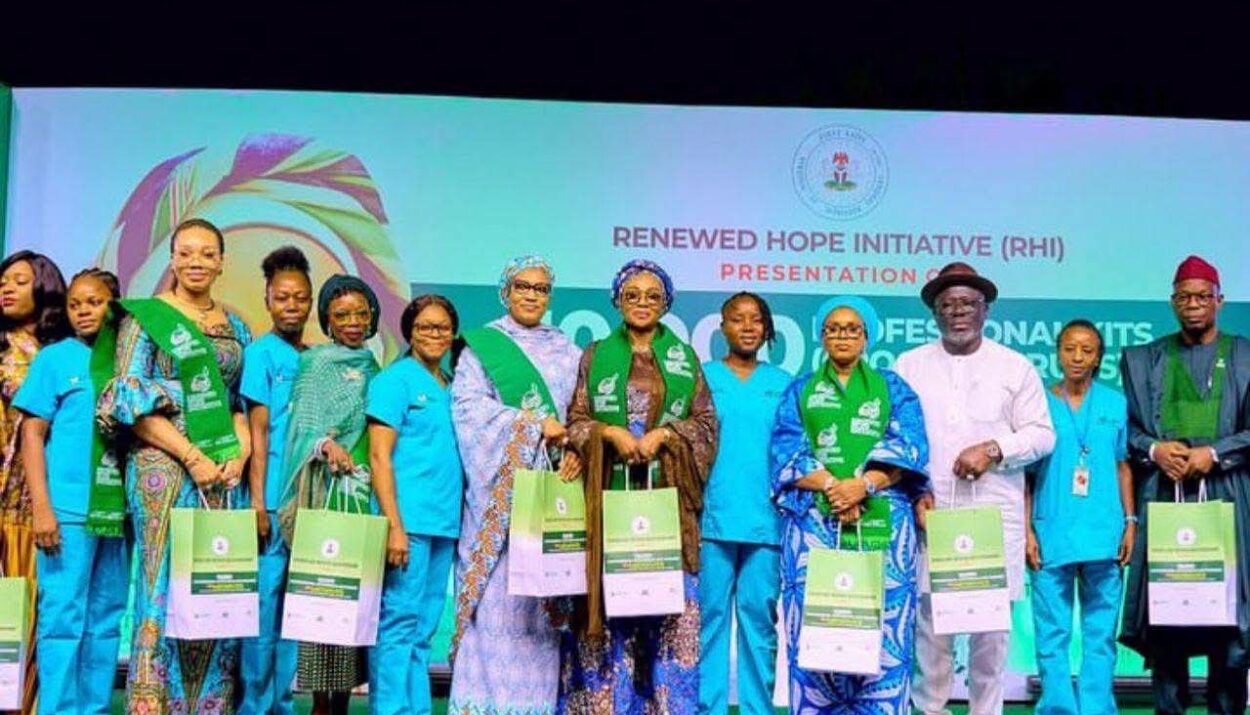
She also highlighted other interventions undertaken through the initiative, including N2 billion for tuberculosis programmes, N1 billion for breast cancer support and N500 million towards tackling food malnutrition. She concluded by encouraging Nigerians to remain hopeful despite the country’s economic difficulties, stressing that hope is central to the philosophy of the Renewed Hope Agenda.
Unfortunately, it was not these humanitarian interventions that captured public attention. Instead, her reference to akara, roasted corn and kuli-kuli became the subject of widespread ridicule. Critics portrayed her remarks as evidence that the government had reduced its economic vision to roadside trading. Memes flooded social media, and many commentators accused her of trivialising the hardship faced by ordinary Nigerians. But that interpretation misses the point.
The First Lady was not unveiling the Federal Government’s economic blueprint. She was not presenting akara, roasted corn or kuli-kuli as substitutes for industrialisation, manufacturing or large-scale investment. She was speaking specifically about women who had received grants through an empowerment programme designed to help vulnerable citizens establish small businesses capable of generating immediate income. Her examples were illustrations of accessible enterprises that require little capital, not prescriptions for Nigeria’s national economic strategy.
Context matters. Words detached from context often produce conclusions that the speaker never intended. Across Nigeria, millions of hardworking men and women survive through small-scale trading. They sell akara in the morning, roast corn by the roadside in the evenings, sell groundnuts, fry fish, prepare pap, sell vegetables, fruits and snacks in neighbourhoods and markets. These occupations may not attract headlines, but they feed families, educate children and sustain communities. In every city and village, these micro-businesses form part of the informal economy that keeps daily life moving. They may not appear in glossy economic reports, yet they provide livelihoods for millions of Nigerians who might otherwise have no source of income.
In Owerri, where I have lived much of my life, I know several families whose fortunes were built through modest trading. Some parents sold groundnuts and painstakingly trained their children through secondary school and university. Others survived by frying fish, akara, potatoes and plantain. Some combined akara with pap to provide affordable breakfasts for workers and students every morning. Through consistency, discipline and honest labour, they raised responsible families and earned the respect of their communities.
My own story is not different. Growing up, I sold groundnuts and hawked kerosene. Those experiences taught me lessons no classroom could offer. They taught me discipline, resilience, responsibility and the dignity of labour. They also taught me that no honest work is beneath anyone willing to improve his or her circumstances. That is why I find it difficult to understand why some Nigerians reacted as though mentioning petty trading amounted to insulting the poor. Ironically, many of those mocking the First Lady today were themselves raised by parents who engaged in similar occupations or once depended on such businesses before attaining greater economic stability.
Somewhere along the way, we developed an unhealthy obsession with white-collar employment. We increasingly measure success by office jobs, government appointments or corporate titles while looking down on artisans, traders and self-employed entrepreneurs. We have unconsciously created the impression that unless someone works in an air-conditioned office, he or she has somehow failed. Nothing could be further from the truth.
Around the world, small businesses remain the foundation upon which larger enterprises are built. Many successful entrepreneurs did not begin with factories, shopping malls or multinational corporations. They started with tiny businesses, roadside kiosks, family shops or market stalls. They expanded gradually through persistence, savings and reinvestment.
There is no shame in humble beginnings. Indeed, history repeatedly shows that modest beginnings often produce remarkable outcomes. This is not to deny Nigeria’s economic challenges. Inflation remains an issue the government is battling with. Many families are struggling with the high cost of food, transportation and essential services. Unemployment and underemployment remain significant concerns, particularly among young people. Citizens are entitled to question government policies and demand better economic outcomes as constructive criticism is indispensable in a democracy.
However, legitimate criticism should not come at the expense of honesty or context. The First Lady’s remarks were not intended to dismiss the scale of Nigeria’s economic problems. They were intended to encourage vulnerable women to use grants productively rather than consume them immediately. She was communicating a simple principle: modest capital, when invested wisely, can become the beginning of financial independence. That principle is neither new nor controversial.
Across Africa and much of the developing world, micro-enterprises have long served as pathways out of poverty. Countless development agencies, financial institutions and non-governmental organisations have invested in microcredit and small-business support because they recognise that low-capital enterprises often provide the quickest route to household income for those excluded from formal employment.
The Renewed Hope Initiative, led by the First Lady, appears to embrace that same philosophy. While the Federal Government pursues broader economic reforms, infrastructure development, investment promotion, industrial expansion and job creation, the First Lady’s intervention focuses on those who cannot wait for large-scale economic transformation before putting food on the table. There is room for both approaches. Macroeconomic reforms and grassroots empowerment are not mutually exclusive. One addresses structural challenges; the other responds to immediate human needs. One seeks long-term national prosperity; the other helps vulnerable families survive the present while preparing for a more secure future.
Critics who reduced the First Lady’s speech to “selling akara and roasted corn” overlooked both her audience and her purpose. She was speaking primarily to widows, unemployed women and economically disadvantaged Nigerians for whom a relatively modest grant can represent a life-changing opportunity. Her message was not that every Nigerian should become a roadside trader. It was that no honest enterprise is too small to become the first step towards self-reliance.
Perhaps what this debate has revealed is not merely disagreement over the First Lady’s words, but a deeper societal attitude towards labour itself. We celebrate billionaires but sometimes mock the struggling trader. We admire successful entrepreneurs but forget that many of them began with very little. We encourage hard work in theory yet occasionally ridicule those who engage in the very occupations that sustain millions of households. That attitude deserves reconsideration. No society prospers by despising honest labour. Every economy depends on people who create value at every level, from the roadside food vendor to the industrial manufacturer, from the market woman to the technology entrepreneur. Each contributes in different ways to national productivity and economic resilience.
We should continue to hold public officials accountable. We should continue to debate policies, question priorities and demand better governance. But we should also resist the temptation to strip public statements of their context simply because doing so creates outrage or viral social media content. The First Lady’s remarks deserve to be understood within the setting in which they were made. She was encouraging enterprise among vulnerable women who had received grants, not prescribing Nigeria’s economic destiny.
Every meaningful journey out of poverty begins somewhere. For some, it begins with a university degree. For others, it begins with a skill acquired through apprenticeship. For many Nigerians, it begins with a tray of akara, roasted corn, groundnuts, fish or kuli-kuli sold with determination and dignity. There is honour in such labour. There always has been. Many of us are products of those humble beginnings. Our parents sacrificed through petty trading so that we could receive an education, pursue careers and aspire to greater opportunities. We dishonour those sacrifices when we treat such occupations with contempt.
After all, many of us – including this writer – were made from petty trading.